Audit & assurance for AI agents.
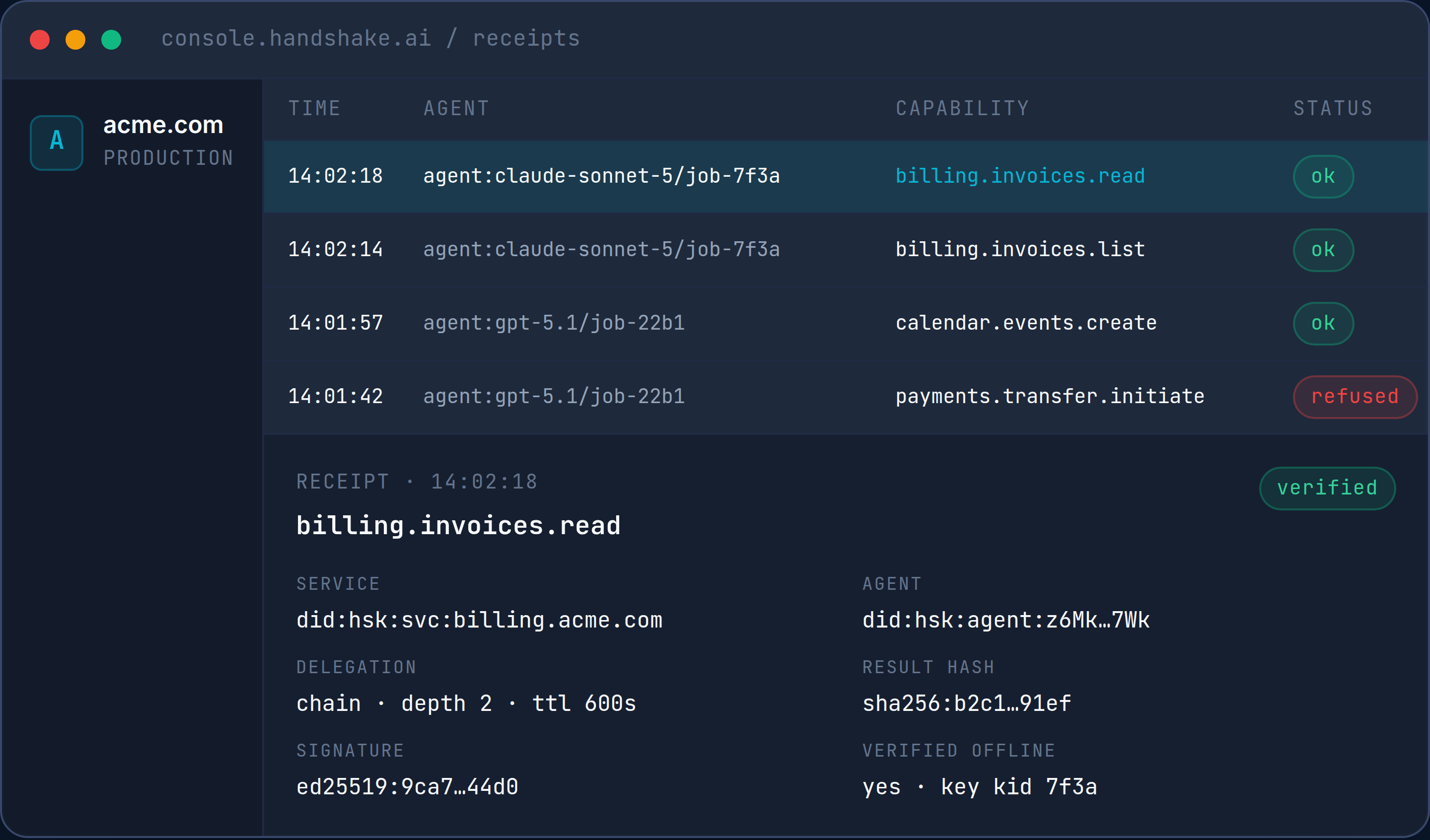
Every meaningful agent action ships with a signed receipt that commits to a hash of the result, names the issuing service's DID, and verifies offline against its public key. MCP, A2A, and AP2 defer the audit layer to “a future layer.” This is that layer.
Open protocol underneath. Hosted Registry and enterprise Console on top. Same shape as Stripe on payment rails or Auth0 on OAuth.
Security review is killing your agent pilot.
Your CISO is asking three questions. Today you can't answer any of them with evidence. Until you can, the pilot doesn't ship, and every Fortune 500 has the same conversation.
Agent identity is unverifiable.
When an agent calls an API, MCP server, or another agent, the receiving side has no cryptographic way to know who deployed it, what model is behind it, or whether its instructions were tampered with mid-flight.
Authority can't be delegated safely.
A user authorizes Agent A. A spawns sub-agent B. B calls Tool C, which calls Service D. By the time D is asked to act, there is no verifiable chain proving the user actually consented to D being called for this purpose, with these constraints, by this specific instance of B, on behalf of this specific session of A. The information existed at every hop. None of it survived.
No signed audit trail.
Logs aren't proof.
Four primitives. One handshake.
Before two agents (or an agent and a service) do meaningful work together, they perform a handshake. Each side proves who they are, what they're authorized to do, and on whose behalf. Every action that follows is sealed with a signed receipt.
Cryptographic agent identity
Every agent has a keypair and a verifiable credential bound to its deployer, model, version, and instance. Lightweight DID-compatible identifiers (did:hsk:agent:…) mean any party can verify any agent without phoning home.
Provable chain of consent
User → agent → sub-agent → tool. Each step carries a signed delegation token narrowing scope and constraints. The receiving side can verify the entire chain back to a human principal, without trusting any intermediate.
Negotiated, scoped capabilities
A handshake is a typed negotiation, not a blank check. Capabilities are namespaced (billing.invoices.read), bound by constraints (max records, date range, TTL), and refused by default if not explicitly granted upstream. Refusals are themselves signed, so a denial is provable.
Signed action attestations
Every meaningful action produces a signed receipt: what was promised, what was done, by whom, with a hash of the result. Receipts chain. Audit becomes a math problem.
One library call. Every action provable.
Handshake is designed to be invisible to the agent author. The SDK wraps your existing agent framework, adds the handshake to outbound calls, and produces signed receipts as a side effect of normal operation.
User authorizes the agent
The user signs a delegation token specifying scope, constraints, and TTL. This is the root of trust. Every downstream action traces back to it.
Agent initiates a handshake
Before calling a service, the agent sends a signed handshake message: its identity, the requested capability, the delegation chain, and the constraints it's operating under.
Service verifies and accepts
The service verifies signatures, walks the delegation chain, and confirms the requested capability is in scope. Either it accepts, or it refuses. No accept, no action. Refusals are signed too.
Action executes, receipt is sealed
The service runs the action, hashes the result, and returns a signed receipt. The receipt persists to the agent, the deployer, and (optionally) a tamper-evident registry.
{
  "handshake": {
    "version": "0.2.3",
    "from": {
      "agent_id": "did:hsk:agent:0xa1b2c3…",
      "deployer": "acme.com",
      "model": "claude-sonnet-5",
      "instance_id": "session-7f3a"
    },
    "to": {
      "service_id": "did:hsk:svc:0xd4e5f6…",
      "capability": "billing.invoices.read"
    },
    "scope": {
      "capabilities": ["billing.invoices.read"],
      "constraints": {
        "max_invoices": 100,
        "date_range": ["2026-01-01", "2026-04-29"]
      },
      "ttl_seconds": 600
    },
    "delegation_chain": [
      {
        "principal": "did:hsk:user:bob@acme.com",
        "authorized": ["billing.invoices.read"],
        "signed_at": "2026-04-29T14:02:11Z",
        "signature": "0x…"
      },
      {
        "principal": "did:hsk:agent:0xa1b2c3…",
        "authorized": ["billing.invoices.read"],
        "signed_at": "2026-04-29T14:14:32Z",
        "signature": "0x…"
      }
    ],
    "signature": "0x…"
  }
}
import { verifyReceipt } from "@handshake-ai/handshake/browser";

// Pass any handshake envelope or receipt; the verifier is fail-closed.
const result = await verifyReceipt(envelope, {
  registryBaseUrl: "https://registry.handshake.ai",
});

if (result.ok) {
  // Signature, delegation chain, and constraints all verified.
} else {
  console.error("verification failed:", result.reason);
}
Designed to fit the protocols you already use.
We wrap an attestation envelope around the protocols defining how agents talk to tools and to each other. Nothing gets replaced. The existing stack stays exactly where it is, and the things it already does well keep working. We add the audit layer those specs explicitly punted on.
Wraps MCP tool calls in a verifiable handshake; signed receipts cover every tool invocation.
Provides the identity and delegation primitives A2A's spec defers to "an external trust layer."
Uses OAuth flows to bootstrap user delegation; carries the authority forward into agent-to-agent calls.
Plugs in as the attestation layer for AP2's mandate model. Provable receipts for every payment action.
Open-protocol audit and assurance for AI agents. Cross-vendor by design.
Four things converged inside eighteen months. The audit-and-assurance gap is the one piece nobody else is shipping a protocol for.
MCP went mainstream
Anthropic, OpenAI, and Google all shipped agent capabilities. Tool ecosystems exploded, and so did supply-chain incidents.
A2A & AP2 launched
Google shipped Agent2Agent. Visa and Mastercard launched AP2 for agent payments. Both explicitly defer trust and identity to "a future layer."
Enterprise pilots stalled
Security and procurement reviews started killing agent rollouts. The blocker is consistent: "we can't audit what the agent did, on whose authority."
Regulation arrives
EU AI Act accountability provisions take effect. SOC2 and ISO scoping for agentic systems becomes a board-level question.
Open spec first. Hosted infra second.
The protocol ships in the open with a small group of design partners. Hosted infrastructure follows.
v0.2.3 spec, Early Access. v0.1 → v0.2.0 → v0.2.3 shipped iteratively (see /spec change log). Working with first design partners.
SDK preview. Python and TypeScript SDKs ship in early access. Reference implementations for Anthropic SDK, OpenAI Agents SDK, LangGraph.
Production Registry beta. Hosted discovery and revocation directory. Optional, like CT logs for TLS.
Console GA. Policy management, audit reporting, compliance evidence export for security teams.
v1.0 spec → standards body. RFC submission via IETF. Multi-vendor implementations and interoperability testing.
Get on a call with the people building this.
We work directly with security and platform teams shipping agents into production. Spec input, white-glove integration help, and a direct line to engineering.